
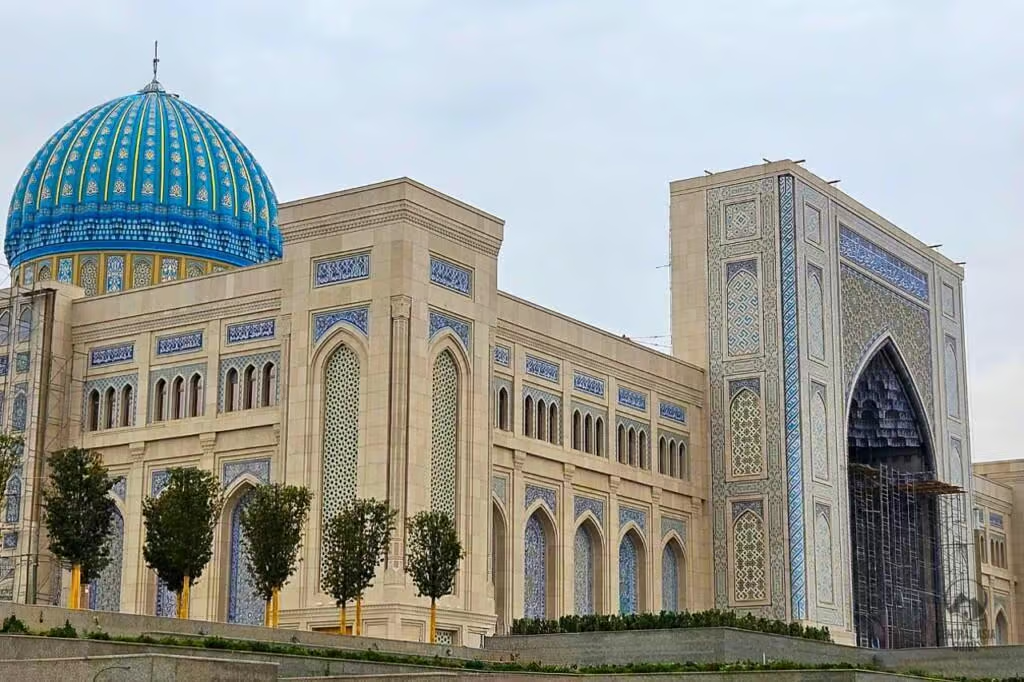
Hazrati Imam Complex
Sacred Spiritual Center & Custodian of the Uthman Quran
Tashkent's principal Islamic architectural ensemble, home to historic madrasas, serene courtyards, and the sacred 7th-century Uthman Quran manuscript.
Old City (Sibzar District), Tashkent
Islamic Memorial & Religious Ensemble
Origins from 10th century; prominent structures 16th century & 2007
Ensemble centered on Abu Bakr Kaffal Shashi; rebuilt & expanded over centuries
Islamic spiritual scholarship, veneration of scholars, and religious assembly
1.5 – 2 hours
What is Hazrati Imam Complex?
The Hazrati Imam Complex (popularly known as Hast-Imam) represents the spiritual heart of Tashkent. Set amidst the labyrinthine adobe lanes of the Old City, it is a grand architectural ensemble comprising the Barak-Khan Madrasa, the Tilla Sheikh Mosque, the Muyi Mubarak Madrasa (library museum), the Hazrati Imam Juma Mosque, and the mausoleum of Abu Bakr Muhammad Kaffal Shashi. It serves both as the administrative seat of the Muslim Board of Uzbekistan and as the nation's premier repository of medieval Islamic manuscripts.
Chronicles & Story
During the Soviet period, religious practice was suppressed across the region, yet in 1943 the Spiritual Administration of the Muslims of Central Asia and Kazakhstan was re-established here, preserving its status as the regional religious authority. Following Uzbekistan's independence, Hast-Imam regained its prominent role. Its crowning treasure is the venerated Uthman (Samarkand) Quran, preserved in the Muyi Mubarak Madrasa. This ancient deerskin parchment codex, dating back to the mid-7th century and stained with the blood of the third Caliph Uthman ibn Affan, is universally recognized as one of the oldest surviving Quranic manuscripts in existence.
Who Created It and Why?
The ensemble arose around the tomb of Abu Bakr Muhammad ibn Ali ibn Ismail al-Qaffal al-Shashi, an illustrious 10th-century Islamic scholar, jurist, poet, and key figure of the Shafi'i legal school born in Tashkent. In the 16th century, the Shaybanid rulers of Tashkent, notably Nauruz Ahmad Khan (nicknamed Barak-Khan), elevated the sanctuary into an intellectual and religious focal point by erecting monumental educational madrasas.
Established: The oldest existing structure is the Kaffal Shashi Mausoleum, originally established following the saint's death in 976 AD and reconstructed in its present form in 1541–1542 by master architect Gholam Husayn. The adjacent Barak-Khan Madrasa was completed between 1531 and 1532. In 2007, a comprehensive restoration and expansion commissioned by the government added the monumental Hazrati Imam Mosque with two 53-meter minarets.
Architecture & Landscape Features
The architecture exemplifies the synthesis of classical Central Asian design and contemporary Uzbek craftsmanship. The Barak-Khan Madrasa features a grand pishtaq adorned with intricate mosaic tilework, majolica inscriptions, and ribbed azure domes. The modern Hazrati Imam Mosque displays open-air summer galleries (aiwans) supported by hand-carved sandalwood and elm columns, with interiors adorned with gold leaf (kundal) and geometric muqarnas vaulting.
The Manuscript Heritage of Hast-Imam
Beyond its monumental brick arches, Hazrati Imam is an internationally acclaimed center of Islamic codicology and manuscript preservation.
The Holy Uthman Quran
Written in early Hijazi script on thick deerskin parchment, this 7th-century codex is a world-renowned relic of early Islamic history.
Barak-Khan Madrasa
A masterwork of 16th-century Shaybanid architecture with two turquoise cupolas and artisan workshops occupying ancient student cells.
Kaffal Shashi Mausoleum
An austere yet deeply spiritual dome-capped tomb honoring the 10th-century polymath and patron saint of Tashkent.
Hand-Carved Aiwans
Grand colonnaded porticos carved by master craftsmen from Kokand, Tashkent, and Samarkand without a single metallic nail.
What Can You Do Here?
View the Uthman Quran
Step into the temperature-controlled chamber of Muyi Mubarak Madrasa to view the world's oldest surviving Quranic pages.
Photograph the Courtyard at Sunset
Capture the golden hour light reflecting across the polished marble plaza and turquoise glazed domes.
Explore the Old City Mahallas
Wander through the adjacent winding earthen alleys of Sibzar, observing traditional adobe houses and grapevine courtyards.
Observe Sacred Architecture
Admire the intricate ganch plaster carving and floral wood craftsmanship in the open summer galleries.
What Will You Discover?
Tashkent's Islamic Scholarly Standing
Understand how Tashkent developed as a prominent center of Islamic jurisprudence and Hadith scholarship alongside Bukhara and Samarkand.
The Journey of the Uthman Quran
Learn how the sacred manuscript traveled from Medina to Damascus, Baghdad, Samarkand, St. Petersburg, Ufa, and finally to Tashkent in 1924.
Contemporary Uzbek Craft Traditions
Appreciate how modern 21st-century renovations faithfully preserve centuries-old woodworking, mosaic laying, and ganch carving techniques.
Nearby Experiences
After exploring the complex, walk southward through the historic Old City mahallas toward Chorsu Bazaar (approx. 20-minute walk or short taxi ride) to experience the contrast between solemn spirituality and vibrant marketplace trade.
Continue Your Journey Through Uzbekistan
Tashkent connects directly by fast Afrosiyob rail to Samarkand, Bukhara, and Khiva.
.jpg) Timurid Capital
Timurid CapitalSamarkand
Turquoise double-domes, astronomical observatories, and vibrant paper mills.
.jpg) Spiritual Oasis
Spiritual OasisBukhara
Medieval madrasas, trading domes, and quiet shaded courtyards.
.jpg) Desert Citadel
Desert CitadelKhiva
Walled mudbrick open-air museum glowing amber at desert sunset.
Plan Your Visit to Hazrati Imam Complex
Our local travel specialists craft personalized Uzbekistan itineraries connecting Tashkent with mountain escapes and Silk Road cities.