
State Museum of the Temurids History
A Grand Showcase of Central Asia's Imperial Renaissance
A turquoise-domed circular museum showcasing medieval weaponry, illuminated cartography, astronomical charts, and treasures from the Timurid Empire.
1 Amir Timur Avenue, Central Tashkent
National Historical & Cultural Museum
Inaugurated September 1996 for the 660th anniversary of Amir Timur's birth
Government of Uzbekistan; designed by national architect Turdiev
Exposition of the historical, scientific, and cultural heritage of the Timurid dynasty
1 – 1.5 hours
What is State Museum of the Temurids History?
The State Museum of the Temurids History is one of Tashkent's most recognizable civic landmarks. Crowned by a ribbed turquoise cupola modeled directly on the monumental domes of Samarkand, this circular rotunda houses over 5,000 artifacts documenting the rise of the Timurid Empire, the reign of Amir Timur, and the extraordinary renaissance of science, literature, astronomy, and architecture under his descendants, including astronomer-king Ulugh Beg and Emperor Babur.
Chronicles & Story
Amir Timur founded an empire stretching from the Mediterranean to India during the late 14th century, establishing his capital at Samarkand. Under his grandson Ulugh Beg, Samarkand became a world center of astronomy and mathematics, while Herat flourished as the cradle of Persianate poetry and miniature arts under Sultan Husayn Bayqara. The museum meticulously traces this lineage, displaying diplomatic letters exchanged with the kings of France and England, archaeological findings from palace ruins, and intricate armor.
Who Created It and Why?
Built by the state to provide an authoritative institution for historical scholarship and civic education, reaffirming the cultural achievements of the Timurid Renaissance as a core component of Uzbek national identity.
Established: Commissioned in 1996 to coincide with UNESCO's international commemoration of the 660th anniversary of the birth of Amir Timur, the building was constructed in an astonishing seven months by Uzbek artisans and international contractors.
Architecture & Landscape Features
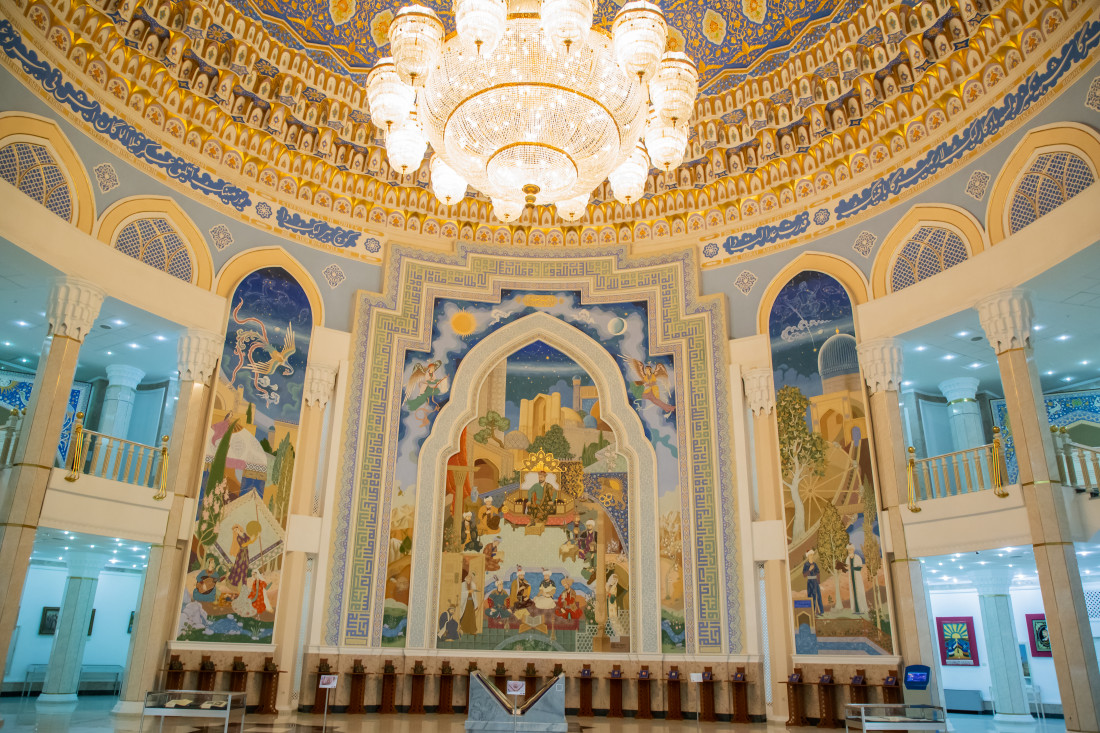
The structure is a round rotunda surrounded by classical white marble columns and crowned by a fluted azure dome inspired by Gur-e-Amir in Samarkand. The interior atrium features a magnificent three-tier crystal chandelier measuring 8.5 meters in height and containing over 2,000 crystal pendants. Walls are covered in large-scale murals by Uzbek master painters illustrating scenes from Timur's life, campaigns, and patronized academies.
What Can You Learn Inside the Rotunda?
The museum's collection is arranged chronologically and thematically across circular galleries surrounding the grand central atrium.
Imperial Weapons & Armor
Damascus steel swords, chainmail suits, battle shields, and ceremonial weaponry used by Timur's warriors on transcontinental campaigns.
Ulugh Beg's Astronomical Legacy
Medieval astrolabes, quadrants, and star catalog facsimiles documenting how Timur's grandson accurately mapped 1,018 stars without a telescope.
Diplomatic Correspondence
Original royal correspondences in Latin, Persian, and Old Turkic exchanged between Timur, King Charles VI of France, and King Henry IV of England.
Architectural Models & Miniatures
Exquisite hand-carved scale models of Registan Square, Bibi-Khanym Mosque, and the Ulugh Beg Observatory.
What Can You Do Here?
Study Medieval Star Catalogs
Examine the scientific achievements of the Samarkand astronomical school founded by Ulugh Beg.
Admire the Grand Central Chandelier
Stand beneath the multi-tiered crystal chandelier suspended in the center of the domed rotunda.
Read Ancient Diplomatic Letters
Discover how fourteenth-century European monarchs courted the Timurid court to establish trade and mutual security.
Photograph the Exterior Columns
Capture the contrast between the pristine white peristyle columns and the deep azure ribbed dome.
What Will You Discover?
The Scope of the Timurid Renaissance
Discover how 15th-century Central Asia flourished in mathematics, medicine, poetry, and astronomy centuries before similar European movements.
Silk Road Diplomacy
Understand how the Timurid state maintained active diplomatic missions across Europe, Ming China, and the Ottoman Empire.
Symbolism in Modern Uzbek Architecture
Observe how modern public architecture intentionally quotes medieval decorative motifs to honor historical continuity.
Nearby Experiences
Directly across the park lies Amir Timur Square, and 10 minutes south along Navoi Avenue brings you to the Navoi Theater and the State Museum of Arts.
Continue Your Journey Through Uzbekistan
Tashkent connects directly by fast Afrosiyob rail to Samarkand, Bukhara, and Khiva.
.jpg) Timurid Capital
Timurid CapitalSamarkand
Turquoise double-domes, astronomical observatories, and vibrant paper mills.
.jpg) Spiritual Oasis
Spiritual OasisBukhara
Medieval madrasas, trading domes, and quiet shaded courtyards.
.jpg) Desert Citadel
Desert CitadelKhiva
Walled mudbrick open-air museum glowing amber at desert sunset.
Plan Your Visit to State Museum of the Temurids History
Our local travel specialists craft personalized Uzbekistan itineraries connecting Tashkent with mountain escapes and Silk Road cities.