
 Historic City & Walls
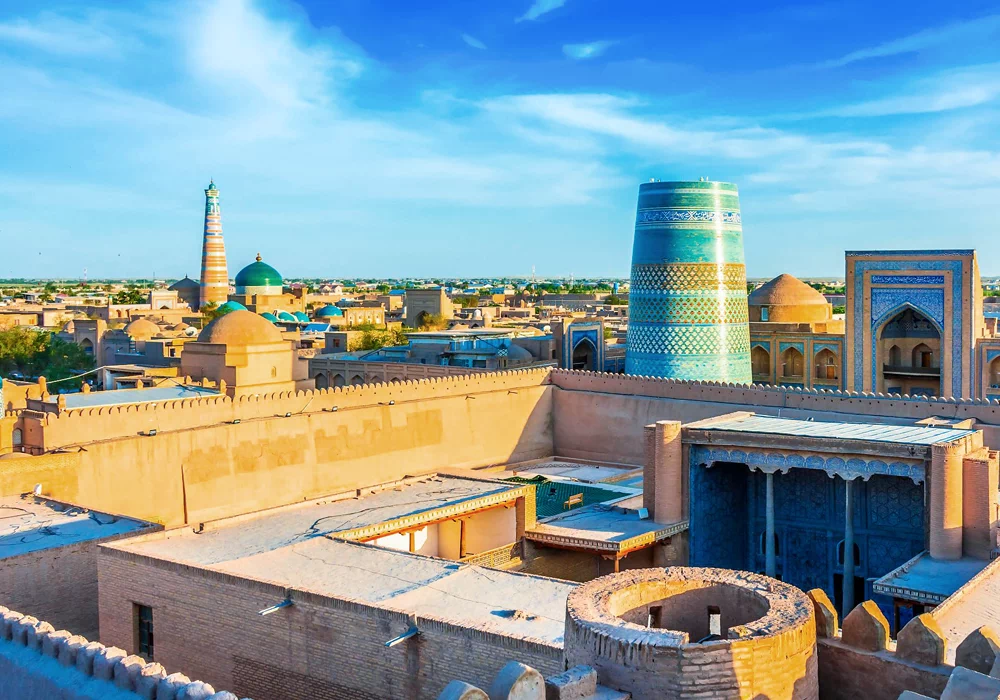
Ichan-Kala (The Historic Walled City)
A completely intact medieval Silk Road city surrounded by two kilometers of undulating mud-brick walls, preserving over fifty historic monuments within a living pedestrian realm.
The Unfinished Turquoise Jewel
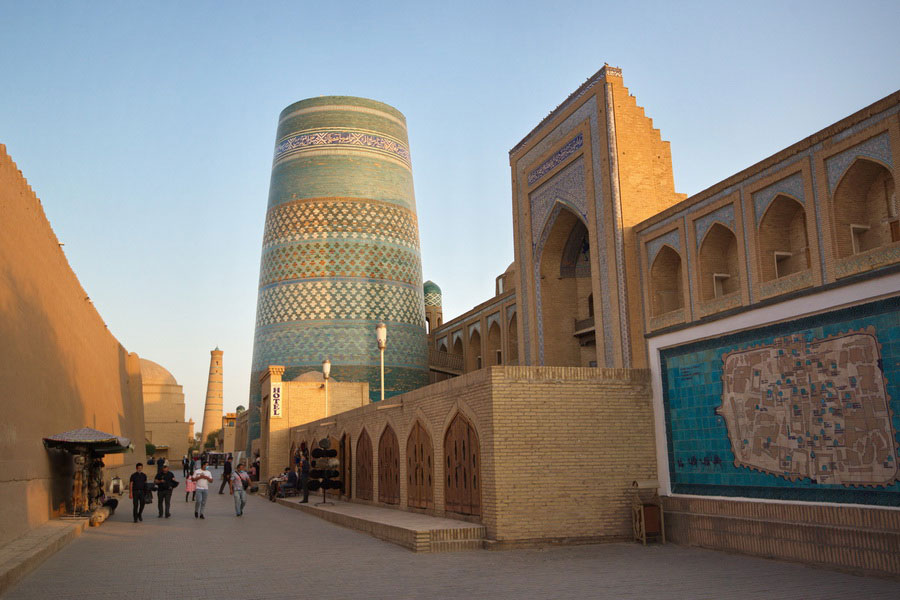
Khiva’s most iconic and photogenic landmark: a colossal, truncated minaret completely wrapped in gleaming azure, turquoise, and white ceramic tilework.
Directly beside Muhammad Amin Khan Madrasa (West Gate)
Unfinished Monumental Minaret
1851 – 1855 CE
Muhammad Amin Khan (Khan of Khiva)
Intended as the tallest minaret in Central Asia (70+ meters)
45 minutes
Kalta Minor (meaning 'Short Minaret') is a stunning architectural marvel. Though standing only 29 meters high, its massive 14.2-meter diameter base and total coverage in shimmering turquoise and cobalt majolica tiles make it one of the most recognizable monuments in the world.
Construction began in 1851 under the ambitious ruler Muhammad Amin Khan. Work came to an abrupt, permanent halt in 1855 when the Khan was killed in battle against Turkmen tribes.
Muhammad Amin Khan commissioned the minaret to outshine Bukhara's Kalyan Minaret. Local legends claim he intended it to be so tall that a muezzin standing at the top could look all the way to Bukhara, 400 kilometers across the desert.
A grand imperial call-to-prayer tower and watchtower symbolizing the supreme power of the Khiva Khanate, attached to Central Asia’s largest madrasa.
An engaging narrative detailing how this monument evolved across Khorezm's golden ages, desert trade conflicts, and modern preservation.
A famous folk legend tells that the Emir of Bukhara, hearing of the minaret's unprecedented beauty, secretly negotiated with the master builder to build an even taller one in Bukhara. When Muhammad Amin Khan discovered the betrayal, he ordered the architect thrown from the tower — but the builder leaped from the scaffolding and fled, leaving the minaret unfinished.
Features you can see with your own eyes: carved elm columns, majolica friezes, adobe brick bonds, and acoustic domes.
Kalta Minor is the only minaret in Central Asia completely encrusted from base to crown in glazed ceramic tiles. It features twenty-nine horizontal bands of geometric, diamond, and floral tiles, creating an optical illusion of shimmering blue water against the desert sand.
Carefully selected activities genuinely relevant to this monument or quarter.
Study the precision of the glazed majolica tiles, noting how no two concentric bands share the same pattern.
Capture the contrast between the saturated blue glaze and the warm adobe mudbrick of the madrasa.
Stand at the base to grasp the sheer girth of the 14-meter-wide foundation.
Core educational takeaways that bring Khiva's Silk Road legacy into sharp perspective.
How Khiva artisans created deep turquoise and cobalt mineral glazes that withstand blistering heat without cracking.
How sudden changes in military fortunes abruptly froze architectural masterworks across the Silk Road.
Courtyard teahouses, woodcarving studios, and quiet residential lanes right around this site.
The adjoining Muhammad Amin Khan Madrasa now houses the unique Orient Star Hotel; enjoy tea inside its historical vaulted brick student cells.
Explore other walled landmarks and quarters connected with this site's history or walking circuit.
Historic City & WallsA completely intact medieval Silk Road city surrounded by two kilometers of undulating mud-brick walls, preserving over fifty historic monuments within a living pedestrian realm.
 Royal Palaces & Fortresses
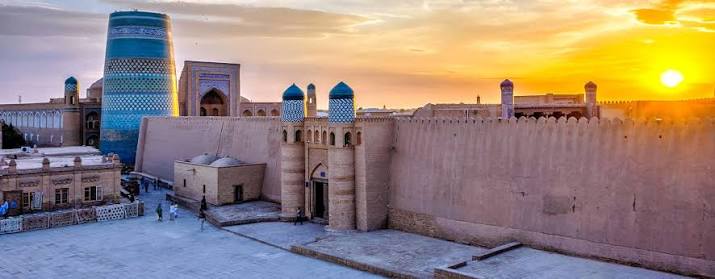
A fortified royal fortress-citadel within Ichan-Kala, housing the Khan's summer reception hall, mint, throne room, and the famous Ak-Sheikh Bobo watchtower.
 Historic City & Walls
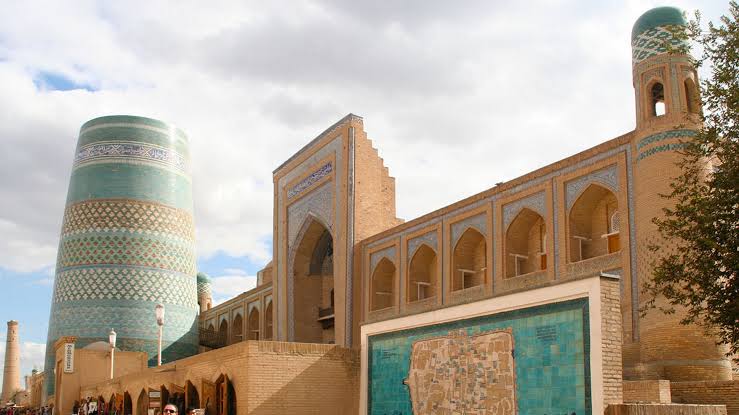
A monumental two-story madrasa capable of housing 260 students, featuring double-roomed hujras, five towering domes, and a majestic high-arched portal.
Looking for something beyond this monument? Discover royal fortresses, sacred woodcarvings, or Silk Road bazaar alleys.
A fortified royal fortress-citadel within Ichan-Kala, housing the Khan's summer reception hall, mint, throne room, and the famous Ak-Sheikh Bobo watchtower.
One of the most atmospheric religious spaces in Central Asia: an unadorned single-story hall supported by 218 uniquely carved antique wooden columns dating from the 10th to 18th centuries.
.jpg)
Experience Ichan-Kala, royal desert palaces, and ancient Silk Road trading chambers with expert Khorezm cultural guides and seamless logistics.