
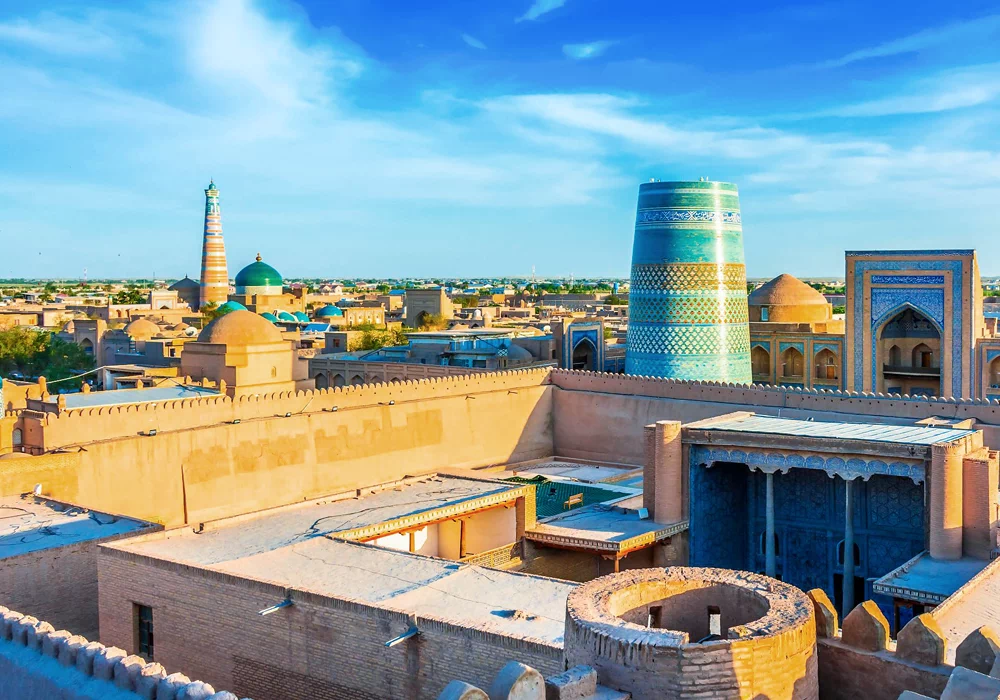
 Historic City & Walls
Ichan-Kala (The Historic Walled City)
A completely intact medieval Silk Road city surrounded by two kilometers of undulating mud-brick walls, preserving over fifty historic monuments within a living pedestrian realm.
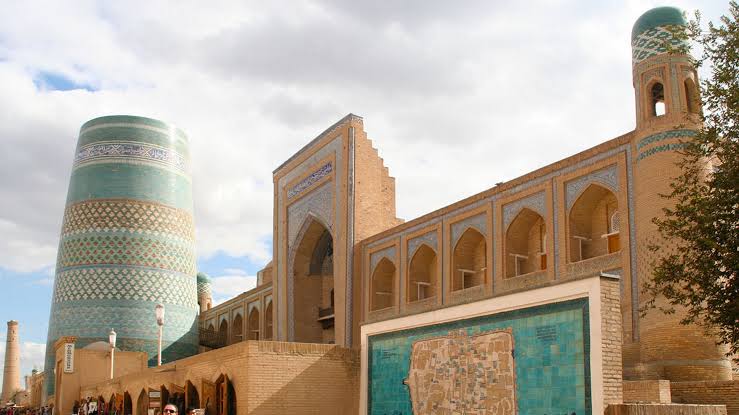
Central Asia's Largest Medieval College
A monumental two-story madrasa capable of housing 260 students, featuring double-roomed hujras, five towering domes, and a majestic high-arched portal.
Immediately inside Ota Darvoza (West Gate)
Imperial Madrasa (Currently Historic Hotel)
1851 – 1854 CE
Muhammad Amin Khan (Khan of Khiva)
Supreme theological college and supreme Islamic court of Khiva
45 minutes
The largest medieval madrasa in Khiva and one of the grandest in Central Asia, measuring 72 by 60 meters. Featuring a vast inner courtyard surrounded by 130 student cells (hujras), it was Central Asia’s only madrasa where student rooms were built with two rooms (a study and a bedroom) and private balconies.
Constructed between 1851 and 1854 by order of Muhammad Amin Khan, directly alongside his unfinished Kalta Minor minaret.
Built by the Khan as a state university that would rival the greatest academic institutions of Bukhara and Samarkand, financed by royal state endowments (waqf).
Higher education in Quranic exegesis, Islamic jurisprudence (fiqh), Arabic literature, and logic. It also served as the seat of the Supreme Islamic Court (Kazi-Kalan).
An engaging narrative detailing how this monument evolved across Khorezm's golden ages, desert trade conflicts, and modern preservation.
The madrasa was wealthy and influential: revenue from vast tracts of royal agricultural land was dedicated to feeding its scholars and paying student stipends. In the late 20th century, it was sensitively repurposed into a historic hotel, allowing travelers to sleep in the restored vaulted brick cells.
Features you can see with your own eyes: carved elm columns, majolica friezes, adobe brick bonds, and acoustic domes.
Features five decorative domes, corner towers with open lantern cupolas, and an imposing entrance portal (pishtaq) decorated with glazed tiles, majolica floral rosettes, and an Arabic inscription over the portal: 'This faithful building will forever gladden the descendants.'
Carefully selected activities genuinely relevant to this monument or quarter.
Walk through the entrance into the immense two-tiered courtyard with its arched student loggias.
Observe the unique two-room residential layout designed for elite scholars.
Relax with tea inside the historic hotel courtyard admiring Kalta Minor towering above the roofline.
Core educational takeaways that bring Khiva's Silk Road legacy into sharp perspective.
How 19th-century Khivan builders improved student living standards by adding exterior wooden loggias.
How historic monuments can be sustainably preserved through sensitive, respectful hospitality conversions.
Courtyard teahouses, woodcarving studios, and quiet residential lanes right around this site.
Positioned at the very entrance of Ichan-Kala, steps away from the ticket office, Kunya-Ark, and foreign money exchanges.
Explore other walled landmarks and quarters connected with this site's history or walking circuit.
Historic City & WallsA completely intact medieval Silk Road city surrounded by two kilometers of undulating mud-brick walls, preserving over fifty historic monuments within a living pedestrian realm.
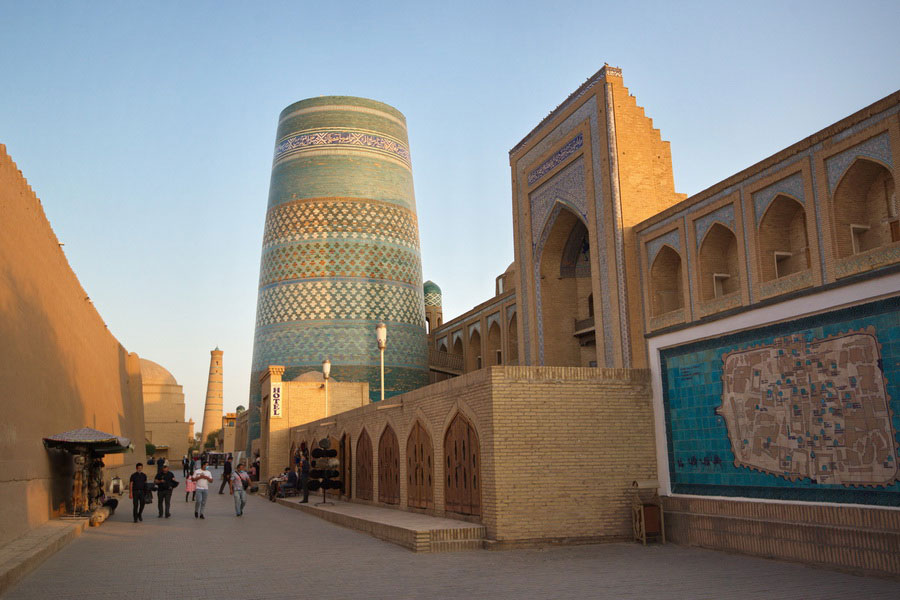 Historic City & Walls
Khiva’s most iconic and photogenic landmark: a colossal, truncated minaret completely wrapped in gleaming azure, turquoise, and white ceramic tilework.
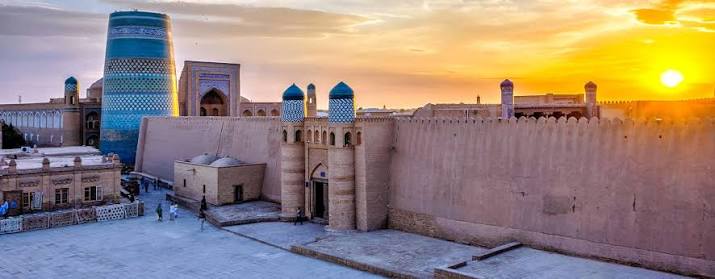 Royal Palaces & Fortresses
A fortified royal fortress-citadel within Ichan-Kala, housing the Khan's summer reception hall, mint, throne room, and the famous Ak-Sheikh Bobo watchtower.
Looking for something beyond this monument? Discover royal fortresses, sacred woodcarvings, or Silk Road bazaar alleys.
A fortified royal fortress-citadel within Ichan-Kala, housing the Khan's summer reception hall, mint, throne room, and the famous Ak-Sheikh Bobo watchtower.
One of the most atmospheric religious spaces in Central Asia: an unadorned single-story hall supported by 218 uniquely carved antique wooden columns dating from the 10th to 18th centuries.
.jpg)
Experience Ichan-Kala, royal desert palaces, and ancient Silk Road trading chambers with expert Khorezm cultural guides and seamless logistics.