
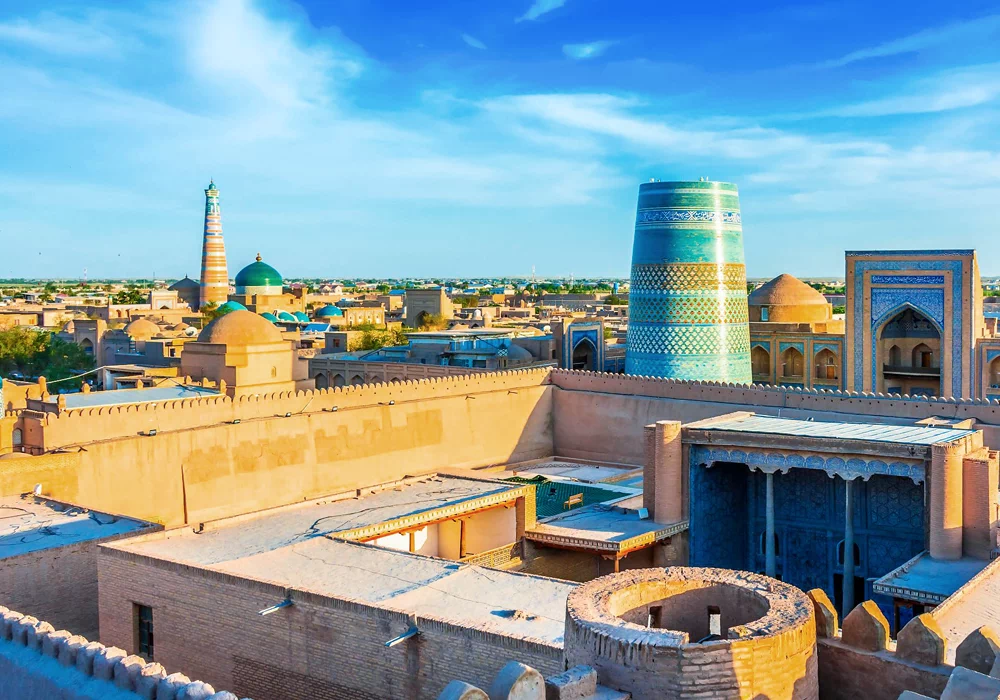
 Historic City & Walls
Ichan-Kala (The Historic Walled City)
A completely intact medieval Silk Road city surrounded by two kilometers of undulating mud-brick walls, preserving over fifty historic monuments within a living pedestrian realm.
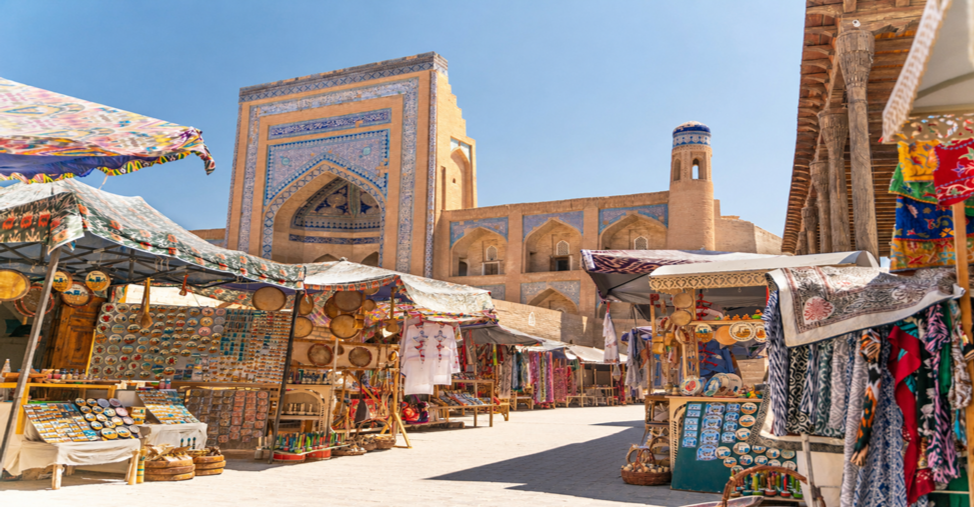
The Commercial Epicenter of the Silk Road
A monumental 19th-century merchant complex combining an enormous two-story caravanserai with the multi-domed covered Tim bazaar, where trans-Eurasian caravans traded.
Directly connected to Palvan Darvoza (East Gate)
Covered Market (Tim)
1832 – 1838 CE
Allakuli Khan
Wholesale Silk Road trading hub
1 – 1.5 hours
The pulsating commercial heart of historic Khiva. This complex merges a massive rectangular caravanserai with 105 rooms for foreign merchants, connected directly to the covered trading dome avenue known as the Tim Allakuli Khan, where luxury silks, Chinese porcelain, and furs were bartered.
Constructed between 1832 and 1838 by Allakuli Khan during an era of tremendous economic prosperity in the Khiva Khanate.
Commissioned by the Khan to provide secure, tax-controlled facilities for international merchants arriving from Russia, Persia, Afghanistan, and the Steppes.
The ground floor housed trade stables and secure brick warehouse vaults, while upper rooms accommodated merchants and trade factors. The covered Tim street sheltered traders from the desert sun.
An engaging narrative detailing how this monument evolved across Khorezm's golden ages, desert trade conflicts, and modern preservation.
Located strategically at the East Gate (Palvan Darvoza), caravans unloaded directly inside the caravanserai without traversing residential neighborhoods. Customs officials inspected manifests, weighed goods, and collected tariffs that financed Khiva’s lavish architectural projects.
Features you can see with your own eyes: carved elm columns, majolica friezes, adobe brick bonds, and acoustic domes.
The Tim is covered by a central dome and fourteen smaller vaulted cupolas. The caravanserai resembles a madrasa in its two-story perimeter layout, but with wide ground-floor doorways designed to accommodate pack camels and heavy merchant carts.
Carefully selected activities genuinely relevant to this monument or quarter.
Inspect authentic hand-loomed ikat silks, camel wool blankets, and sheepskin chugirma hats.
Follow the stone path through the ancient East Gate where caravans historically entered.
Sample sweet sun-dried Khorezm melons braided into sweet rolls by market vendors.
Core educational takeaways that bring Khiva's Silk Road legacy into sharp perspective.
How Silk Road oasis cities structured customs, security, currency conversion, and storage.
Why traditional massive wool hats remain the ultimate thermal headwear against both desert sun and freezing winter winds.
Courtyard teahouses, woodcarving studios, and quiet residential lanes right around this site.
Step through the East Gate into the bustling modern town market outside the walls, where fresh fruit, tandir bread, and shashlik smoke fill the air.
Explore other walled landmarks and quarters connected with this site's history or walking circuit.
Historic City & WallsA completely intact medieval Silk Road city surrounded by two kilometers of undulating mud-brick walls, preserving over fifty historic monuments within a living pedestrian realm.
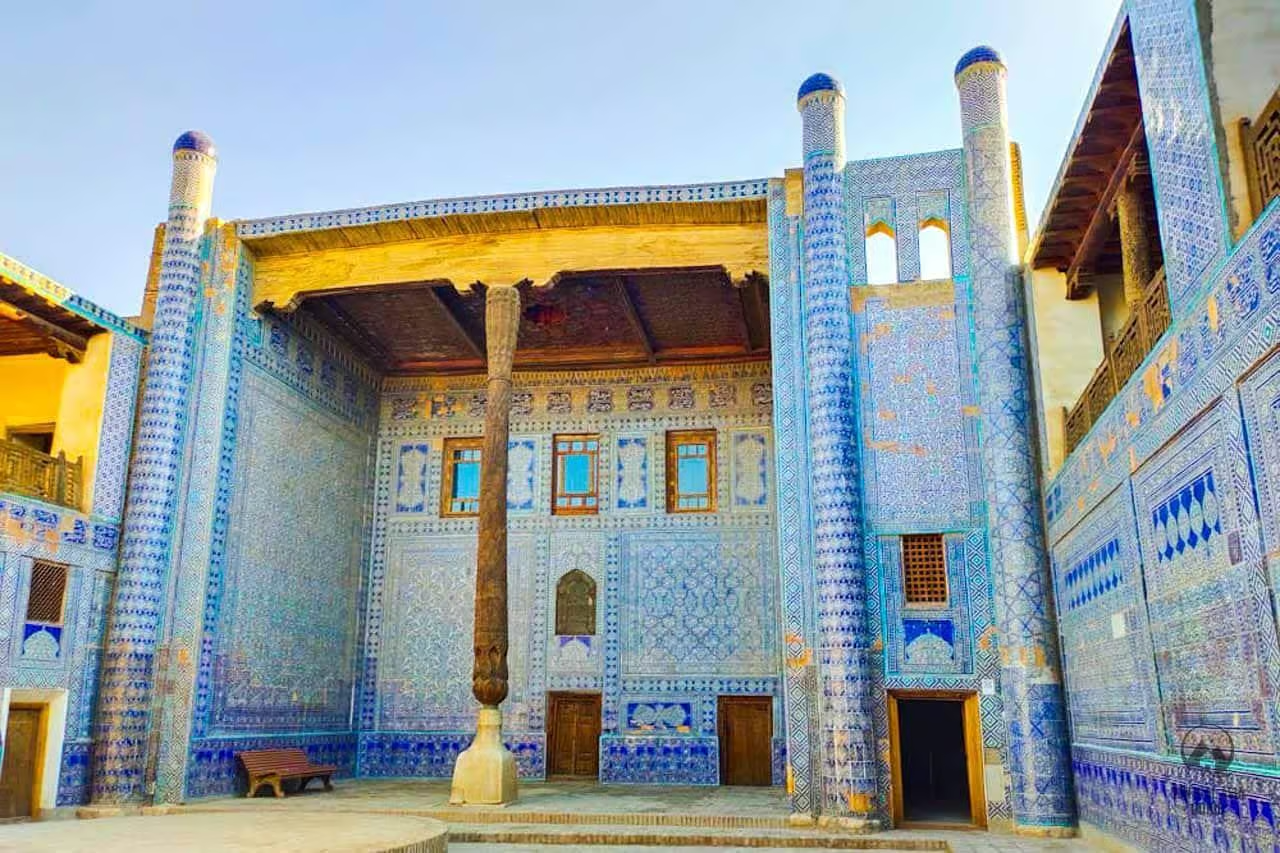 Royal Palaces & Fortresses
An opulent 19th-century royal palace containing over 150 rooms and three grand courtyards, smothered in the most dense, hypnotic cobalt and turquoise majolica tiles in Uzbekistan.
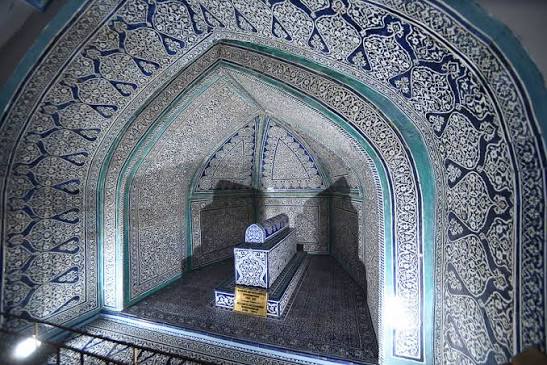 Sacred Mosques & Shrines
The spiritual heart of Khiva: an exquisite turquoise-domed complex honoring Khiva's patron saint — a legendary wrestler, poet, furrier, and philosopher revered across Central Asia.
Looking for something beyond this monument? Discover royal fortresses, sacred woodcarvings, or Silk Road bazaar alleys.
A completely intact medieval Silk Road city surrounded by two kilometers of undulating mud-brick walls, preserving over fifty historic monuments within a living pedestrian realm.
Khiva’s most iconic and photogenic landmark: a colossal, truncated minaret completely wrapped in gleaming azure, turquoise, and white ceramic tilework.
.jpg)
Experience Ichan-Kala, royal desert palaces, and ancient Silk Road trading chambers with expert Khorezm cultural guides and seamless logistics.